


Clean, stable water quality is the foundation of any successful beverage, food, or industrial production line. Whether the end product is bottled water, carbonated drinks, juice, or process water for manufacturing, effective pretreatment determines not only product quality but also equipment lifespan and operating costs. Among the many filtration technologies available today, multi-media filters have become a proven, practical solution for improving water treatment efficiency across a wide range of applications.
This article explains how multi-media filters work, why they outperform single-media filtration in many scenarios, and how they fit into modern, integrated water treatment and beverage production systems. It also looks at how Pengxiang Huixing applies this technology within complete, intelligent water treatment and liquid packaging solutions for global customers.
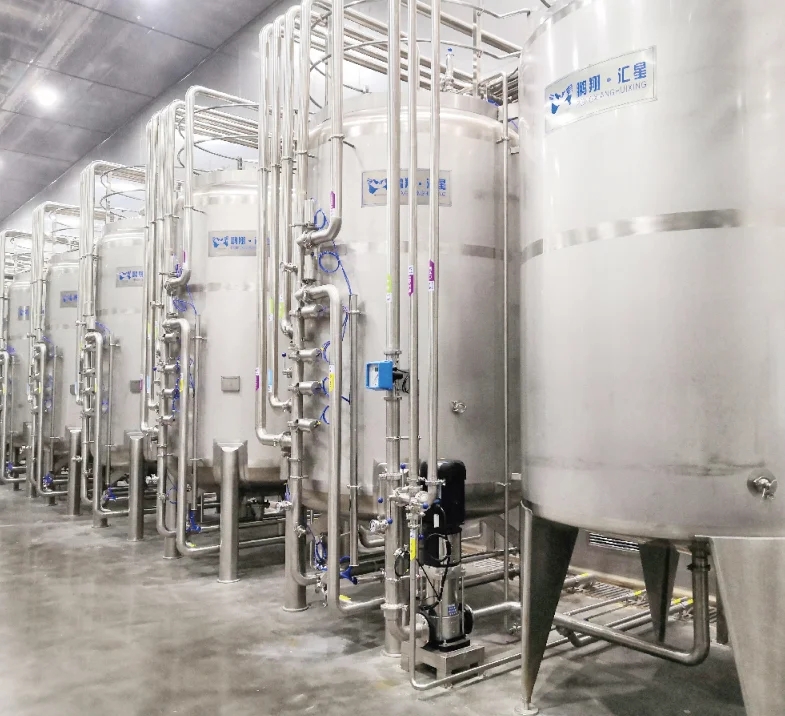
Understanding Multi-media Filtration
A multi-media filter is a pressure or gravity filtration system that uses multiple layers of different filter media, typically arranged from coarse to fine. Common materials include anthracite, quartz sand, garnet, or other graded media. Each layer has a specific particle size and density, allowing the filter to capture contaminants throughout the entire depth of the filter bed rather than only on the surface.
Unlike single-layer sand filters, which tend to clog quickly at the top, multi-media filters distribute solids removal more evenly. Larger particles are trapped in the upper layers, while finer particles are captured deeper in the bed. This depth filtration mechanism is the key to higher efficiency and longer operating cycles.
How Multi-media Filters Improve Water Treatment Efficiency
1. Higher Suspended Solids Removal
One of the main advantages of multi-media filters is their ability to remove a wider range of suspended solids in a single pass. Turbidity, rust, silt, organic matter, and other particulates are effectively reduced, resulting in clearer water with more consistent quality. This is especially important for beverage applications where clarity directly affects appearance and consumer perception.
2. Longer Filtration Cycles
Because particles are captured throughout the filter bed, multi-media filters can operate for longer periods before backwashing is required. This reduces downtime, saves water during cleaning cycles, and improves overall system availability. In high-output production environments, fewer interruptions translate directly into higher efficiency.
3. Lower Pressure Drop
Compared with fine single-media filters, multi-media systems typically maintain a lower pressure drop over time. Stable pressure conditions help protect downstream equipment such as membranes, filling valves, and CIP systems. This contributes to smoother operation and reduced energy consumption across the production line.
4. Improved Protection for Downstream Processes
Multi-media filters are often installed upstream of more sensitive treatment stages such as activated carbon filtration, softening, reverse osmosis, or UV sterilization. By removing the bulk of suspended solids early, they reduce fouling and extend the service life of downstream components. This layered approach to water treatment improves both performance and reliability.
Applications in Beverage and Industrial Water Systems
Multi-media filters are widely used in:
-
Bottled water and mineral water production
-
Juice and carbonated beverage lines
-
Brewing and dairy processing
-
Industrial process water treatment
-
Municipal and commercial water pretreatment
In beverage plants, stable pretreatment is critical. Variations in raw water quality can cause fluctuations in taste, color, and microbiological safety. Multi-media filters provide a robust first barrier that helps standardize incoming water before it enters more precise treatment stages.
Integration with Complete Water Treatment Lines
Modern water treatment is no longer about standalone equipment. Efficiency comes from how well each component works as part of a complete system. Pengxiang Huixing designs and manufactures integrated water treatment production lines where multi-media filters play a central role in pretreatment.
These systems are engineered to match specific raw water conditions and production requirements. Parameters such as flow rate, turbidity levels, and operating pressure are carefully analyzed during project planning. As a customer-focused solution partner, Pengxiang Huixing supports clients from initial needs assessment through system design, installation, and commissioning.
Role in Intelligent Factories and Smart Workshops
As beverage manufacturers move toward intelligent workshops and smart factories, water treatment systems must also evolve. Automation, data monitoring, and system integration are becoming standard requirements. Multi-media filters are well suited to this environment because they are reliable, predictable, and easy to integrate with automated control systems.
Pengxiang Huixing focuses on high-end planning and design for intelligent factories. Its water treatment systems can be equipped with automatic valves, pressure sensors, and PLC control, allowing backwashing cycles to be triggered based on pressure differential or operating time. This reduces manual intervention and ensures consistent filtration performance.
When connected to upstream procurement systems and downstream filling, packaging, warehousing, and logistics processes, water treatment becomes part of a fully optimized production ecosystem.
Supporting Equipment Longevity and Product Quality
Water quality directly affects the lifespan of beverage packaging machinery. Particulates and impurities can cause abrasion, clogging, and scaling in blow molding machines, filling valves, sterilization units, and CIP systems. By improving pretreatment efficiency, multi-media filters help protect key assets such as:
-
Fully automatic blow molding machines
-
Bottle filling and capping three-in-one systems
-
Gallon bottle production lines
-
Aseptic filling and sterilization equipment
Cleaner water also improves cleaning effectiveness during CIP processes, reducing chemical consumption and improving hygiene standards.
Pengxiang Huixing’s Experience and Global Reach
Based in Songgang Street, Bao’an District, Shenzhen, Pengxiang Huixing is a comprehensive beverage packaging machinery manufacturer integrating R&D and production. For more than 20 years, the company has focused on liquid beverage packaging technology, continuously introducing and improving advanced technologies from around the world.
Its product portfolio includes water treatment production lines, intelligent cleaning systems, on-site automatic cleaning systems, sterilization equipment, PET blow molding machines, blow-fill-cap series production lines, labeling systems, conveying systems, and secondary packaging equipment. All products are developed under ISO9000 quality management standards, and the company has been recognized as a Chinese high-tech enterprise.
Pengxiang Huixing’s solutions are not limited to equipment supply. The company supports customers across the entire value chain, from procurement and production to packaging, warehousing, logistics, distribution, and final consumption. This system-level thinking is especially valuable in water treatment, where integration and reliability are critical.
With installations across more than 20 provinces in China and exports to markets such as the UAE, Oman, Vietnam, the Philippines, and Malaysia, the company has accumulated extensive project experience under diverse water quality conditions.
Practical Considerations When Choosing Multi-media Filters
To fully realize the benefits of multi-media filtration, several practical factors should be considered:
-
Raw water analysis: Accurate data on turbidity, particle size, and seasonal variations is essential for proper media selection.
-
System sizing: Filters must be matched to actual flow rates and peak demand to avoid underperformance.
-
Backwash design: Efficient backwashing ensures long-term stability and consistent filtration efficiency.
-
Integration: Filters should be designed as part of a complete water treatment and production system, not as isolated units.
Experienced manufacturers with system integration capabilities can help avoid common pitfalls and ensure reliable long-term operation.
Conclusion
Multi-media filters are a proven, cost-effective way to improve water treatment efficiency in beverage and industrial applications. By combining depth filtration, long operating cycles, and stable performance, they provide cleaner water, protect downstream equipment, and support consistent product quality.
When integrated into complete, intelligently designed water treatment and packaging systems, multi-media filters become more than just filtration devices. They are a key element in building efficient, reliable, and scalable production lines. With its long-term focus on innovation, system integration, and global project experience, Pengxiang Huixing continues to apply this technology to help customers achieve stable operations and sustainable growth.