


Water quality has become one of the most important factors affecting manufacturing efficiency, product consistency, and equipment lifespan across industries. In beverage production, food processing, pharmaceuticals, and industrial manufacturing, a stable water treatment process is essential for maintaining production standards and reducing operational risks.
Among the many pretreatment technologies available today, multi-media filters remain one of the most practical and cost-effective solutions for removing suspended solids, turbidity, and particulate contaminants before advanced purification processes such as reverse osmosis or ultrafiltration.
However, not all multi-media filters perform at the same level. Their efficiency depends not only on the filter media itself but also on the engineering design, internal structure, automation level, and integration with the entire water treatment system.
This article explores the key design features that make modern multi-media filters more efficient and explains how equipment manufacturers such as Pengxiang Huixing continue improving water treatment performance through intelligent engineering and integrated beverage production solutions.
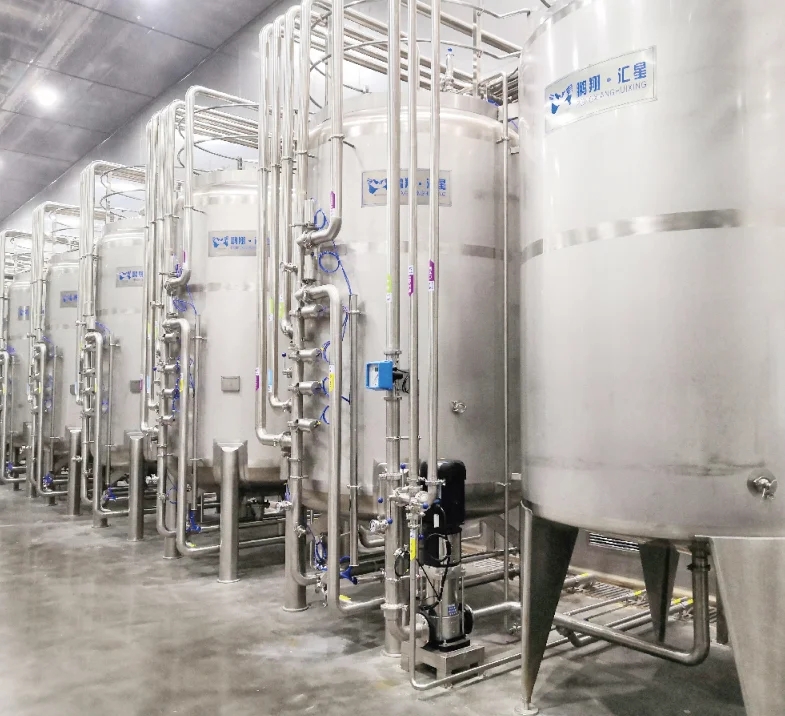
Why Multi-media Filters Remain Essential
A multi-media filter uses multiple layers of filtration materials with different particle sizes and densities. Instead of relying on a single filtration layer, contaminants are captured progressively throughout the media bed.
A typical filter may include:
-
Anthracite
-
Quartz sand
-
Fine silica sand
-
Garnet or supporting gravel
Because larger particles are trapped near the top while smaller particles penetrate deeper into the media, the entire filtration bed is utilized more effectively.
This layered structure provides several advantages:
-
Higher dirt-holding capacity
-
Lower pressure loss
-
Longer filtration cycles
-
Improved water clarity
-
Reduced downstream equipment fouling
These benefits explain why multi-media filters remain a standard component in modern industrial water treatment systems.
Optimized Media Layer Design
One of the biggest factors influencing filtration efficiency is the arrangement of the filtration media.
Modern engineering focuses on balancing:
-
Media density
-
Particle size
-
Layer thickness
-
Hydraulic flow characteristics
Instead of allowing contaminants to accumulate only at the surface, optimized media grading distributes solids throughout the filter bed.
This approach provides:
-
Higher filtration capacity
-
Better contaminant retention
-
Longer operating time before backwashing
-
Reduced maintenance frequency
Proper media selection also helps improve performance when treating water with varying turbidity levels.
Uniform Water Distribution
Even the highest-quality filter media cannot perform well if incoming water is distributed unevenly.
Modern multi-media filters use specially designed inlet distributors that spread water evenly across the entire filter surface.
Uniform distribution prevents:
-
Channeling
-
Dead zones
-
Uneven loading
-
Premature media clogging
The result is more consistent filtration quality throughout the operating cycle.
Likewise, carefully engineered underdrain systems ensure that filtered water is collected evenly while supporting efficient backwashing.
Efficient Backwashing Systems
Backwashing restores filter performance by removing accumulated contaminants from the media bed.
Poor backwash design often leads to:
-
Incomplete cleaning
-
Media compaction
-
Reduced filtration efficiency
-
Higher operating costs
Modern systems improve this process through optimized hydraulic design.
Important features include:
-
Uniform upward water flow
-
Air-water combined backwashing
-
Proper media expansion
-
Automatic backwash sequencing
-
Adjustable cleaning cycles
Efficient backwashing extends media life while maintaining stable filtration performance.
Pressure Vessel Engineering
The filter vessel itself plays a surprisingly important role in overall efficiency.
Well-designed pressure vessels provide:
-
Stable operating pressure
-
Smooth internal flow paths
-
Reduced turbulence
-
Better corrosion resistance
-
Longer service life
High-quality stainless steel construction is widely used in food and beverage applications because it offers excellent hygiene, durability, and resistance to corrosion.
Proper welding, polishing, and structural reinforcement further improve long-term reliability.
Intelligent Flow Control
Traditional manual valve operation increases labor requirements and introduces the possibility of operational errors.
Modern multi-media filters increasingly incorporate automated valve control systems.
These systems can automatically manage:
-
Filtration
-
Backwashing
-
Rinsing
-
Standby modes
-
Alarm monitoring
Automation reduces operator workload while ensuring every filtration cycle follows optimized operating parameters.
This becomes especially valuable in continuous beverage production environments where downtime directly affects productivity.
Accurate Pressure Monitoring
Pressure difference across the filter bed provides valuable information about filter performance.
Modern systems often include pressure transmitters that continuously monitor inlet and outlet pressure.
Operators can easily determine:
-
Media fouling level
-
Backwash timing
-
Flow restrictions
-
System health
Instead of relying on fixed maintenance schedules, facilities can perform cleaning based on actual operating conditions.
This predictive approach improves both efficiency and equipment availability.
Integration with Complete Water Treatment Systems
A multi-media filter rarely operates alone.
Its performance depends heavily on how well it integrates with upstream and downstream equipment.
Typical process flow includes:
Raw Water
↓
Multi-media Filter
↓
Activated Carbon Filter
↓
Softener
↓
Precision Filter
↓
Reverse Osmosis
↓
UV Sterilization
↓
Ozone System
↓
Storage Tank
↓
Production Line
Proper system integration minimizes pressure fluctuations and ensures stable water quality throughout the production process.
Energy-Efficient Hydraulic Design
Reducing energy consumption has become an important design objective for industrial water treatment equipment.
Engineers now optimize hydraulic performance through:
-
Larger effective filtration area
-
Lower pressure drop
-
Improved piping layout
-
Efficient valve selection
-
Optimized pump matching
Lower resistance means pumps consume less energy while maintaining required production capacity.
For facilities operating around the clock, these improvements can significantly reduce overall operating costs.
Smart Control Systems
Digital control technologies have transformed modern water treatment equipment.
Instead of manually adjusting valves and monitoring gauges, operators can manage the entire filtration system through PLC-based automation.
Smart control functions often include:
-
Automatic startup
-
Remote monitoring
-
Flow recording
-
Pressure logging
-
Alarm notifications
-
Historical data analysis
-
Preventive maintenance reminders
These capabilities improve production consistency while supporting intelligent factory management.
Hygienic Design for Beverage Production
In beverage manufacturing, equipment hygiene is just as important as filtration efficiency.
Modern multi-media filters designed for food-grade applications emphasize sanitary construction.
Important design considerations include:
-
Food-grade stainless steel materials
-
Smooth internal surfaces
-
Dead-angle reduction
-
Easy cleaning
-
CIP compatibility
-
Corrosion-resistant components
These features help reduce microbial growth while meeting strict production standards.
Modular Design for Easier Expansion
Production requirements often increase over time.
Modern filter systems increasingly adopt modular designs that allow manufacturers to expand treatment capacity without replacing the complete system.
Benefits include:
-
Faster installation
-
Easier maintenance
-
Flexible production expansion
-
Reduced future investment risk
This flexibility is particularly valuable for growing beverage manufacturers.
Durability of Internal Components
Efficiency is closely related to component reliability.
High-quality internal parts improve long-term performance, including:
-
Stainless steel distributors
-
Corrosion-resistant nozzles
-
Durable valve assemblies
-
Heavy-duty piping
-
High-quality sealing materials
Reliable components minimize maintenance while ensuring consistent filtration over many years of operation.
Customized Engineering for Different Water Sources
No two water sources are identical.
Surface water, groundwater, municipal water, and recycled process water all require different filtration strategies.
Professional equipment manufacturers evaluate:
-
Turbidity
-
Suspended solids
-
Organic matter
-
Seasonal water variation
-
Production capacity
-
Final water quality requirements
Customized engineering allows each filtration system to achieve optimal performance rather than relying on standardized configurations.
Pengxiang Huixing's Approach to Efficient Water Treatment
For more than two decades, Pengxiang Huixing has focused on beverage packaging machinery and complete liquid production solutions. Located in Shenzhen, China, the company integrates research, development, manufacturing, and engineering services into one comprehensive operation.
Its capabilities extend well beyond water treatment equipment, covering complete production solutions that include beverage pretreatment systems, PET blow molding equipment, blow-fill-cap production lines, blow-label-fill-cap production lines, labeling systems, conveying systems, secondary packaging equipment, intelligent cleaning systems, industrial cleaning solutions, sterilization equipment, and complete bottled water, juice, and carbonated beverage production lines.
Pengxiang Huixing also specializes in the planning and implementation of intelligent workshops and smart factories, helping customers optimize every stage of production—from raw material preparation and water treatment to filling, packaging, warehousing, logistics, distribution, and final consumption.
Certified under the ISO9000 Quality Management System and recognized as a Chinese High-Tech Enterprise, the company continues to introduce advanced global beverage packaging technologies while combining them with independent innovation. Its equipment has been supplied throughout more than 20 provinces in China and exported to countries including the United Arab Emirates, Oman, Vietnam, the Philippines, Malaysia, and other international markets.
For manufacturers seeking reliable filtration performance as part of a complete beverage production solution, Pengxiang Huixing's engineered multi-media filter offers an important foundation for stable water quality and efficient operation.
Conclusion
The efficiency of a multi-media filter depends on far more than the filtration media itself. Internal hydraulic design, media grading, pressure vessel engineering, automated control, intelligent monitoring, hygienic construction, and system integration all contribute to long-term performance.
As beverage production becomes increasingly automated and quality requirements continue to rise, manufacturers need filtration equipment that delivers consistent results with minimal maintenance and maximum reliability.
Companies like Pengxiang Huixing demonstrate how continuous engineering innovation, combined with complete production line expertise, can transform a conventional filtration system into a highly efficient component of a modern intelligent factory.