


In modern water treatment systems, achieving consistent water quality is not just a requirement—it is a foundation for reliable production, especially in industries such as beverage manufacturing, food processing, and pharmaceuticals. Among the many technologies used in filtration, multi-media filters play a critical role as a primary purification step. Their efficiency, simplicity, and adaptability make them indispensable in both municipal and industrial water treatment setups.
This article explores the working principle of multi-media filters, their structure, operational advantages, and how they integrate into complete water treatment and beverage production systems.
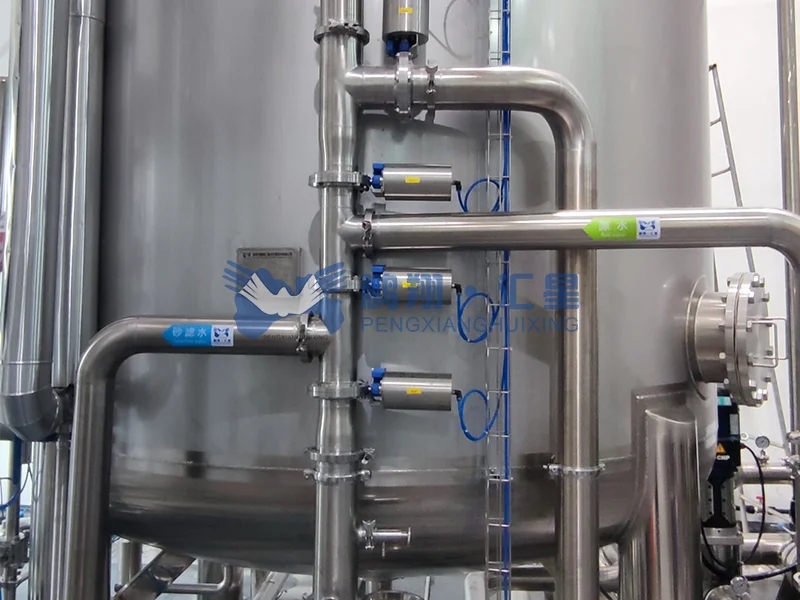
What Is a Multi-media Filter?
A multi-media filter is a depth filtration system that uses multiple layers of filtering materials—typically anthracite, sand, and gravel—to remove suspended solids, turbidity, and particulate matter from water.
Unlike single-layer filters, multi-media filters are designed to trap particles of varying sizes throughout the entire depth of the filter bed. This improves filtration efficiency and extends operational cycles between backwashing.
Structure and Composition
A typical multi-media filter consists of the following layers arranged from top to bottom:
-
Anthracite layer: Coarse and lightweight, captures larger particles
-
Quartz sand layer: Medium-sized granules, removes finer impurities
-
Fine sand layer (optional): Enhances fine particle removal
-
Gravel support layer: Prevents media loss and supports upper layers
Water flows downward through these layers, allowing contaminants to be trapped at different depths based on their size and density.
Working Principle
The working principle of a multi-media filter can be summarized in three key stages:
1. Filtration (Service Mode)
During normal operation, raw water enters the filter from the top and passes through each media layer. The separation process occurs through:
-
Mechanical straining: Larger particles are trapped between media grains
-
Sedimentation: Heavier particles settle within the filter bed
-
Adsorption: Smaller particles adhere to media surfaces
Because of the graded density and size of the media, larger particles are captured near the top, while finer particles are trapped deeper in the filter. This prevents rapid clogging and ensures efficient use of the entire filter bed.
2. Particle Retention and Depth Filtration
Unlike surface filters, multi-media filters rely on depth filtration. This means contaminants are distributed throughout the media layers rather than accumulating only on the surface.
This approach offers several advantages:
-
Higher dirt-holding capacity
-
Longer filtration cycles
-
Reduced pressure drop over time
-
Improved water clarity
3. Backwashing (Cleaning Process)
Over time, trapped particles accumulate and reduce filtration efficiency. To restore performance, the system undergoes backwashing:
-
Water (sometimes combined with air) is pumped upward
-
The filter bed expands and loosens
-
Trapped particles are dislodged and flushed out
Backwashing is essential for maintaining consistent filtration performance and extending the lifespan of the filter media.
Key Advantages of Multi-media Filters
Multi-media filters are widely used because they offer a balance of performance, cost-effectiveness, and operational simplicity.
High Filtration Efficiency
The layered media structure allows for removal of particles as small as 10–20 microns, making it ideal for pre-treatment stages.
Longer Operating Cycles
Depth filtration reduces clogging, allowing longer intervals between cleaning cycles.
Lower Maintenance Costs
Compared to membrane systems, multi-media filters require less frequent replacement and are easier to maintain.
Scalability
They can be designed for small-scale applications or large industrial systems, including complete beverage production lines.
Applications in Industrial Systems
Multi-media filters are used across a wide range of industries, including:
-
Municipal water treatment plants
-
Food and beverage production
-
Pharmaceutical manufacturing
-
Electronics and semiconductor processing
-
Industrial cooling systems
In beverage production, they are particularly important as a pre-treatment step before advanced processes such as reverse osmosis or sterilization.
Integration in Complete Beverage Production Lines
In modern factories, water treatment is not an isolated process—it is integrated into a fully automated production ecosystem. This is where companies like Pengxiang Huixing bring significant value.
With over 20 years of experience, Pengxiang Huixing provides comprehensive solutions that go beyond filtration. Their systems cover:
-
Water treatment and purification
-
Beverage pre-treatment systems
-
PET blow molding equipment
-
Blow-fill-cap and blow-label-fill-cap production lines
-
Labeling systems
-
Conveying systems
-
Secondary packaging equipment
Multi-media filters are typically positioned at the front end of these systems, ensuring that incoming water meets the required quality standards before entering downstream processes.
Role in Smart Factories
As manufacturing evolves toward automation and intelligence, water treatment systems are also becoming more integrated and data-driven.
Pengxiang Huixing specializes in smart workshop and smart factory planning, where multi-media filters are equipped with:
-
Automated control valves
-
Pressure monitoring systems
-
Flow sensors
-
Programmable backwashing cycles
This allows operators to monitor performance in real time, reduce manual intervention, and improve overall system efficiency.
Quality and Reliability
Consistency is critical in industries like bottled water and beverage production. Poor water quality can affect taste, safety, and product shelf life.
Pengxiang Huixing ensures reliability through:
-
ISO9000-certified quality management systems
-
Advanced manufacturing and R&D capabilities
-
Proven installations across more than 20 domestic provinces
-
Export experience in markets such as the UAE, Oman, Vietnam, the Philippines, and Malaysia
Their multi-media filters are designed to integrate seamlessly with other systems such as sterilization units, CIP (clean-in-place) systems, and complete filling lines.
Practical Considerations for Selection
When selecting a multi-media filter, several factors should be considered:
Water Quality
The level of turbidity and type of contaminants will determine the filter design and media configuration.
Flow Rate
System capacity must match production requirements without compromising filtration efficiency.
Automation Level
Modern systems benefit from automated control to reduce labor and improve consistency.
Integration Needs
Filters should be compatible with upstream and downstream equipment in the production line.
Conclusion
Multi-media filters remain a cornerstone of water treatment systems due to their simplicity, efficiency, and adaptability. By leveraging depth filtration and layered media, they provide reliable removal of suspended solids while maintaining cost-effective operation.
In advanced industrial environments, especially in beverage production, these filters are not standalone units but part of a fully integrated system. Companies like Pengxiang Huixing demonstrate how combining filtration technology with intelligent manufacturing and complete production solutions can significantly enhance operational efficiency and product quality.
As industries continue to demand higher standards and smarter systems, the role of multi-media filters will only become more important in ensuring clean, consistent, and safe water for production.