


Water treatment is a foundational process across industries such as food and beverage manufacturing, pharmaceuticals, municipal supply, and industrial production. As water quality requirements become stricter and production environments become more automated, the choice between membrane treatment systems and traditional water treatment methods has become a key engineering decision. Each approach has its own strengths, limitations, and suitable applications, especially in modern beverage production lines where consistency, hygiene, and efficiency are critical.
Understanding Traditional Water Treatment Methods
Traditional water treatment methods have been widely used for decades and are still common in many facilities today. These systems typically rely on physical, chemical, and biological processes to remove contaminants from raw water sources.
A conventional treatment train usually includes:
-
Coagulation and flocculation to aggregate suspended particles
-
Sedimentation to allow heavier solids to settle
-
Sand or multimedia filtration for further particle removal
-
Disinfection using chlorine, ozone, or UV to eliminate microorganisms
These processes are effective for general water clarification and are often suitable for municipal-scale treatment. However, traditional systems tend to require larger footprints, more chemical usage, and more frequent operational intervention. Water quality consistency can also fluctuate depending on raw water variability and system control precision.
In industrial applications such as beverage production, these variations can directly affect product quality, equipment stability, and downstream processing efficiency.
The Rise of Membrane Treatment Systems
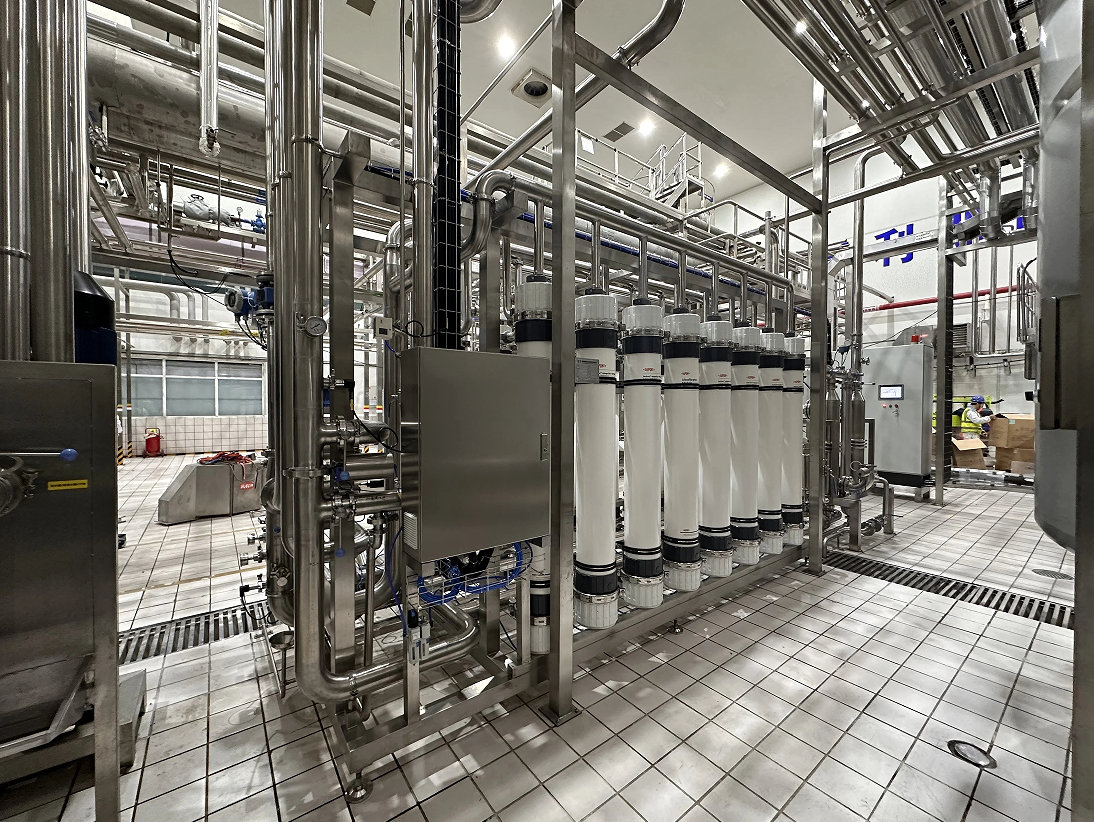
Membrane-based filtration technologies represent a more advanced and precise approach to water purification. Instead of relying heavily on chemical reactions and gravity-based separation, membrane systems use semi-permeable barriers to physically separate contaminants based on molecular size.
Common membrane processes include:
-
Microfiltration (MF)
-
Ultrafiltration (UF)
-
Nanofiltration (NF)
-
Reverse Osmosis (RO)
Each stage targets different levels of impurities, from suspended solids and bacteria to dissolved salts and organic molecules.
Modern industrial solutions often integrate multiple stages into a single automated system, improving stability and reducing human intervention.
A typical industrial membrane solution can be explored here:
This type of system is increasingly adopted in industries that demand high-purity water with consistent output quality, especially beverage manufacturing and precision processing environments.
Key Differences Between Membrane and Traditional Systems
1. Filtration Precision and Water Quality
Traditional systems are effective for removing visible impurities and reducing turbidity, but they may struggle to consistently remove dissolved solids or microorganisms without additional chemical treatment.
Membrane systems, by contrast, provide a much higher level of filtration precision. RO systems, for example, can remove dissolved salts and most organic compounds, producing highly stable water quality suitable for sensitive production processes.
2. Chemical Usage and Environmental Impact
Traditional treatment processes often rely heavily on chemical additives such as coagulants, disinfectants, and pH adjusters. This increases operational complexity and requires careful handling and storage.
Membrane systems significantly reduce chemical dependency. While pre-treatment chemicals may still be used to protect membranes, overall consumption is lower, making the system more environmentally friendly and easier to manage in long-term operation.
3. Operational Stability and Automation
Traditional water treatment systems often require manual monitoring and adjustment, especially when raw water quality changes.
Membrane systems are typically designed with higher levels of automation. Pressure, flow rate, and filtration performance can be continuously monitored and adjusted through control systems, improving stability and reducing operator workload.
4. Space and Infrastructure Requirements
Conventional treatment plants usually require multiple tanks and large sedimentation structures, which increase installation space and construction complexity.
Membrane systems are more compact and modular, making them suitable for modern manufacturing plants where space optimization is essential.
5. Maintenance and Lifecycle Considerations
Traditional systems often involve routine sludge handling, chemical replenishment, and periodic cleaning of large tanks.
Membrane systems require membrane cleaning (CIP – clean-in-place) and periodic replacement of membrane elements. While this demands technical management, it also provides predictable maintenance cycles and easier system control.
Importance in Beverage Manufacturing
In the beverage industry, water is not just a utility—it is the core ingredient. Whether producing bottled water, juice, carbonated drinks, or functional beverages, water quality directly determines product safety, taste stability, and shelf life.
Membrane systems are particularly important in:
-
Bottled mineral and purified water production
-
Juice and tea beverage processing
-
Carbonated beverage preparation
-
Pre-treatment for sterile filling systems
Consistent water quality ensures stable formulation and reduces risks in downstream filling and packaging equipment.
Traditional systems may still be used in some facilities, but they often require additional polishing steps to meet the strict hygiene and quality standards of modern beverage production lines.
Integrated Solutions in Modern Industrial Systems
Companies operating in beverage machinery and water treatment engineering increasingly provide integrated solutions rather than standalone equipment. One such example is Pengxiang Huixing, a comprehensive manufacturer specializing in beverage packaging machinery and intelligent factory planning.
The company provides global clients with:
-
Water treatment and beverage pre-treatment systems
-
PET blow molding equipment
-
Blow-fill-cap integrated production lines
-
Blow-label-fill-cap systems
-
Labeling systems and conveying systems
-
Secondary packaging and logistics equipment
With a focus on smart workshop and intelligent factory design, the company integrates water treatment technology into full production ecosystems. This includes everything from raw water purification to final packaging, warehousing, and distribution.
Operating from Shenzhen, China, Pengxiang Huixing has built a strong manufacturing foundation supported by ISO9000 certification and recognition as a national high-tech enterprise. Over two decades of development, the company has continuously introduced and improved global beverage machinery technologies, forming a competitive advantage in both domestic and international markets.
Its equipment has been exported to multiple countries and regions, including the Middle East and Southeast Asia, where beverage production demand continues to grow.
How Membrane Systems Fit Into Smart Manufacturing
In modern intelligent factories, water treatment is no longer a standalone utility—it is part of a connected production ecosystem. Membrane systems integrate seamlessly with:
-
Automated filling lines
-
Sterilization systems
-
CIP cleaning systems
-
Real-time production monitoring platforms
This integration improves traceability, reduces downtime, and enhances overall production efficiency.
For beverage manufacturers, this means fewer interruptions, more stable product quality, and better alignment with global hygiene standards.
Choosing the Right Water Treatment Approach
The decision between traditional and membrane systems depends on several factors:
-
Required water purity level
-
Production scale and automation level
-
Regulatory and hygiene requirements
-
Budget for long-term operation and maintenance
-
Space availability and plant design
In many modern beverage facilities, hybrid systems are also used, combining traditional pre-treatment with membrane-based polishing for optimal efficiency and cost control.
Conclusion
Both membrane treatment systems and traditional water treatment methods play important roles in industrial water purification. Traditional systems remain valuable for basic treatment and large-scale municipal applications, while membrane systems provide higher precision, better automation, and improved consistency—especially in industries where water quality directly impacts product integrity.
As beverage manufacturing continues to evolve toward smarter, more integrated production environments, membrane technology is becoming a central component of modern water treatment design. With companies like Pengxiang Huixing advancing complete beverage production and intelligent factory solutions, water treatment is now tightly connected to the entire lifecycle of manufacturing, packaging, and distribution.