


Activated carbon filters are widely used in water treatment because they can reduce chlorine, organic compounds, unpleasant odors, tastes, and certain other contaminants. However, simply installing an activated carbon filter does not guarantee stable treatment performance. The actual results depend on a combination of water quality, carbon characteristics, equipment design, operating conditions, and maintenance practices.
For beverage manufacturers, these factors are especially important. Water is often a major ingredient in bottled water, juice, carbonated soft drinks, and other beverages. If the treatment stage is poorly controlled, problems can carry forward into subsequent processes such as blending, sterilization, filling, and packaging.
For companies developing complete beverage production systems, such as Pengxiang Huixing, understanding the practical factors behind filtration performance is essential for designing reliable water treatment and beverage pretreatment systems.
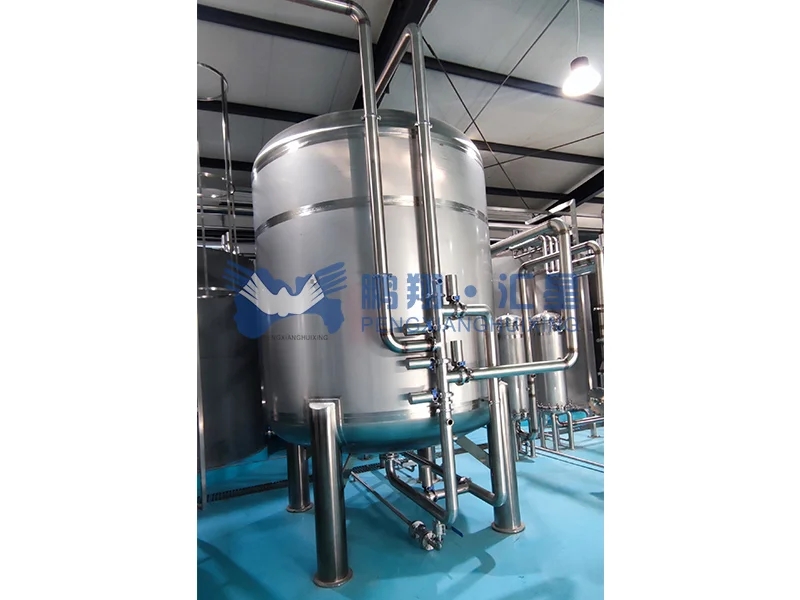
1. Raw Water Quality
The first and perhaps most important factor is the quality of the incoming water.
Activated carbon works through adsorption, meaning contaminants are attracted to and retained on the surface and within the pore structure of the carbon. Different water sources contain different concentrations of chlorine, chloramine, natural organic matter, oils, suspended solids, and other substances. These differences directly affect filter performance and service life.
For example, water containing a high concentration of organic matter can consume the adsorption capacity of activated carbon more quickly. Similarly, high levels of suspended solids can cause premature pressure drop if appropriate prefiltration is not installed.
Before selecting an activated carbon filter, operators should therefore evaluate parameters such as:
-
Turbidity and suspended solids
-
Free chlorine and, where relevant, chloramine
-
Organic matter
-
Iron and manganese
-
Water temperature
-
pH and alkalinity
-
Microbiological conditions
-
Flow rate and daily water consumption
A water analysis provides a much more reliable basis for filter selection than simply choosing equipment according to nominal capacity.
2. Type and Quality of Activated Carbon
Not all activated carbon performs in the same way.
Activated carbon may be manufactured from materials such as coconut shells, coal, or wood, and each material can produce different pore structures and adsorption characteristics. The appropriate carbon depends on the contaminants that need to be controlled.
Particle size is another important consideration. Smaller particles can provide a larger accessible surface area and may offer strong adsorption performance, but they can also create higher pressure loss. Larger particles may allow easier water flow but can behave differently in terms of adsorption kinetics.
Carbon quality also matters. Consistent raw materials, appropriate activation processes, low ash content, and suitable mechanical strength can all contribute to more predictable operation.
For industrial water treatment, the carbon should be selected according to the actual application rather than based only on general product specifications.
3. Contact Time
One of the most important operating parameters is the time water remains in contact with the activated carbon.
This is commonly considered through empty bed contact time (EBCT). If water passes through the filter too quickly, contaminants may not have enough opportunity to interact with the carbon surface. Increasing contact time can improve adsorption performance for many applications.
However, simply slowing the system down is not always the best solution. Production facilities have specific water demands, and excessive contact time can increase equipment size and footprint.
A well-designed system balances treatment performance with the required production capacity. This is particularly important for beverage plants where water consumption may vary between production lines and operating shifts.
4. Flow Rate
Flow rate and contact time are closely related.
When the flow rate increases while the filter volume remains unchanged, the contact time decreases. As a result, certain contaminants may pass through the carbon bed before sufficient adsorption occurs.
High flow rates can also increase pressure loss and may disturb the carbon bed if the system is poorly designed.
For this reason, filter sizing should consider both peak and normal water demand. Designing only for average consumption can create problems during periods of maximum production.
A practical design should account for actual operating conditions, including production schedules, simultaneous water use, cleaning cycles, and possible future capacity increases.
5. Water Temperature
Temperature can influence adsorption behavior and water viscosity.
As water temperature changes, the interaction between contaminants and activated carbon can also change. Temperature affects the physical properties of water and can influence how quickly water moves through the carbon bed.
Although temperature may not be the main design parameter in every application, beverage factories operating in different climates should consider seasonal variations. Equipment designed for a controlled indoor environment may operate differently from equipment installed in a hot production area or exposed to significant environmental changes.
6. Pretreatment Before Activated Carbon Filtration
Activated carbon filters generally perform better when the incoming water has already received appropriate pretreatment.
Large suspended particles, sediment, and other materials can occupy the filter bed and increase pressure loss. In practical systems, sediment filtration or multimedia filtration may therefore be installed upstream of the carbon filter.
Depending on the raw water source, other treatment technologies may also be required.
For example, a complete water treatment system may combine:
Raw Water → Pretreatment → Multimedia Filtration → Activated Carbon Filtration → Precision Filtration → Membrane Treatment → Disinfection → Product Water
The exact configuration depends on the source water and final water quality requirements.
This is why activated carbon should not be considered as an isolated piece of equipment. Its performance is strongly influenced by the treatment stages before and after it.
7. Carbon Bed Depth
The depth of the activated carbon bed affects both contact time and adsorption capacity.
A shallow bed may be sufficient for certain low-load applications, while a deeper bed can provide greater contact opportunity and more adsorption capacity. The correct bed depth depends on water quality, flow rate, carbon characteristics, target contaminants, and system operating requirements.
Uniform water distribution is equally important. If water bypasses part of the carbon bed, the effective treatment volume becomes smaller than the physical filter volume.
Good internal distribution and properly designed inlet and outlet systems help ensure that water passes through the carbon more evenly.
8. Pressure Drop and Carbon Condition
Pressure drop is a useful indicator of filter condition.
As suspended solids accumulate or the carbon bed becomes compacted, resistance to water flow can increase. Excessive pressure drop can reduce system efficiency and indicate that maintenance is needed.
Operators should establish normal pressure ranges and monitor changes over time. A sudden increase in differential pressure may indicate blockage, channeling, poor backwashing, or another operating problem.
Routine inspection and appropriate backwashing can help maintain stable hydraulic performance.
9. Backwashing and Maintenance
Activated carbon filters require practical maintenance, not simply periodic replacement.
Backwashing can remove accumulated particles and help loosen and reclassify the carbon bed. However, the backwash procedure must be properly controlled. Excessive flow can cause carbon loss, while insufficient backwashing may leave contaminants trapped in the bed.
Maintenance schedules should be based on actual operating conditions rather than a fixed calendar alone. Operators should monitor:
-
Differential pressure
-
Flow rate
-
Chlorine removal performance
-
Water quality
-
Backwash frequency
-
Carbon bed condition
-
Operating hours and treated water volume
When adsorption capacity is exhausted, the carbon must be replaced or regenerated according to the system design.
10. Microbiological Control
Activated carbon is highly useful for adsorption, but it should not be treated as a substitute for disinfection.
Because carbon can remove chlorine from water, downstream microbiological control becomes particularly important. If the treated water remains in the system for long periods or equipment hygiene is inadequate, microbial growth can become a concern.
For beverage production, activated carbon filtration is therefore normally integrated with appropriate sanitation and disinfection procedures.
Regular cleaning, controlled water circulation, sanitary piping design, and suitable downstream disinfection help reduce microbiological risks.
11. Equipment Design and Automation
The mechanical design of the filter also influences its performance.
A well-designed activated carbon system should provide appropriate inlet distribution, effective bed support, suitable valves, accessible maintenance points, and reliable flow control.
Automation can further improve consistency by controlling filtration, backwashing, rinsing, and operating sequences. Sensors and control systems can help operators monitor pressure, flow, tank levels, and other important parameters.
For modern beverage plants, this type of automation can connect the water treatment section with the wider production management system, helping operators identify abnormal conditions before they affect production.
Activated Carbon Filtration in Complete Beverage Production Systems
For beverage manufacturers, water treatment is only one part of the overall production process. The quality of treated water can influence blending, beverage taste, equipment cleanliness, and production stability.
Pengxiang Huixing provides solutions covering water treatment and beverage pretreatment systems, PET blow molding equipment, blow-fill-seal production lines, blow-label-fill-seal lines, labeling systems, conveying systems, and secondary packaging equipment. The company also focuses on high-end planning and design for smart workshops and smart factories.
In a complete beverage project, activated carbon filtration can be incorporated into the water treatment section according to raw water characteristics and production requirements. The goal is not simply to install a carbon filter, but to create a coordinated treatment process that provides stable water quality for downstream production.
Pengxiang Huixing's capabilities also extend to bottled water production lines, gallon bottle production lines, juice and carbonated beverage production systems, filling equipment, sterilization equipment, automatic CIP systems, and industrial cleaning solutions. This broader approach allows water treatment and beverage production equipment to be considered as connected processes rather than separate installations.
A Practical Approach to Improving Filter Performance
When an activated carbon filter does not deliver expected results, replacing the carbon immediately is not always the right answer.
A better troubleshooting sequence is to check:
-
Raw water quality: Has the source water changed?
-
Flow rate: Is the actual flow higher than the original design condition?
-
Contact time: Is the filter operating within its intended range?
-
Pressure drop: Is the bed becoming blocked or compacted?
-
Carbon condition: Has the adsorption capacity been exhausted?
-
Water distribution: Is channeling or bypass occurring?
-
Pretreatment: Is excessive sediment reaching the carbon bed?
-
Maintenance: Are backwashing and sanitation procedures being followed?
-
Downstream treatment: Is disinfection properly controlled?
This approach helps identify the actual cause instead of treating every performance problem as a carbon replacement issue.
Conclusion
The performance of an activated carbon filter depends on much more than the carbon itself. Raw water characteristics, carbon type, contact time, flow rate, bed depth, pretreatment, temperature, pressure drop, maintenance, microbiological control, and equipment design all contribute to the final treatment result.
For beverage plants, these factors should be evaluated as part of the complete water treatment and production system. Properly designed activated carbon filtration can provide effective pretreatment while supporting consistent water quality for bottling and beverage manufacturing.
Pengxiang Huixing combines water treatment technology with beverage production and packaging equipment to support integrated solutions from water preparation and beverage processing through filling, labeling, conveying, packaging, and related factory systems. With practical system design and appropriate process control, activated carbon filtration can become a dependable component of a modern beverage production line.
For more information about activated carbon filtration solutions, visit the activated carbon filter page.