

- 1A recent laboratory analysis of your actual source decides the design. Regional averages are not a substitute.
- 2Purified water needs reverse osmosis. Natural mineral water needs ultrafiltration — RO would strip out the minerals that define the product.
- 3Size treated-water output above filler consumption, with margin for CIP, flushing and peak demand.
- 4Pretreatment is not optional. Skipping it to save capital cost raises operating cost permanently.
Most water treatment problems are not equipment failures. They are specification failures — a system sized for the wrong capacity, built for the wrong product standard, or designed from an assumption about the source water rather than a measurement of it.
This guide covers the six decisions that shape a treatment train, in the order an engineer actually works through them.
1. Start with the laboratory analysis
The single document that makes an accurate proposal possible is a recent laboratory analysis of the water you will actually use. Not the municipal average for your region, not last decade's borehole test — the current source.
Different parameters pull the design in different directions:
- ·Turbidity and suspended solids determine how much pre-filtration is needed before anything else.
- ·Hardness decides whether softening or reverse osmosis is required to protect downstream equipment from scaling.
- ·Total dissolved solids influence whether single-pass or double-pass RO is specified.
- ·Iron and manganese, common in groundwater, need dedicated media filtration.
- ·Bromide matters if ozone is used, because ozone can convert it to bromate, which is regulated in drinking water.
- ·Microbiological counts shape the disinfection strategy and the CIP schedule.
Without an analysis, any quotation is an estimate — and estimates are where budgets go wrong. A supplier who quotes a treatment system without asking for your water report is either guessing or planning to revise the price later.
2. Match the product standard, not the strongest process
This is the mistake that costs most, because it is only discovered after production starts.
Reverse osmosis removes dissolved salts. That is exactly what purified bottled water requires. But it is exactly wrong for natural mineral water, where the dissolved mineral profile is the product — strip it out and the water no longer meets the standard it is being sold under.
Ultrafiltration removes suspended solids, colloids, proteins and microorganisms while letting dissolved minerals pass through. That is why mineral and spring water plants use it, and why buying the "strongest" available process can be the wrong decision.
3. RO, UF or NF — comparing the separation processes
Three membrane processes cover most beverage applications. They are not interchangeable.
| Process | Removes | Minerals retained | Typical application |
|---|---|---|---|
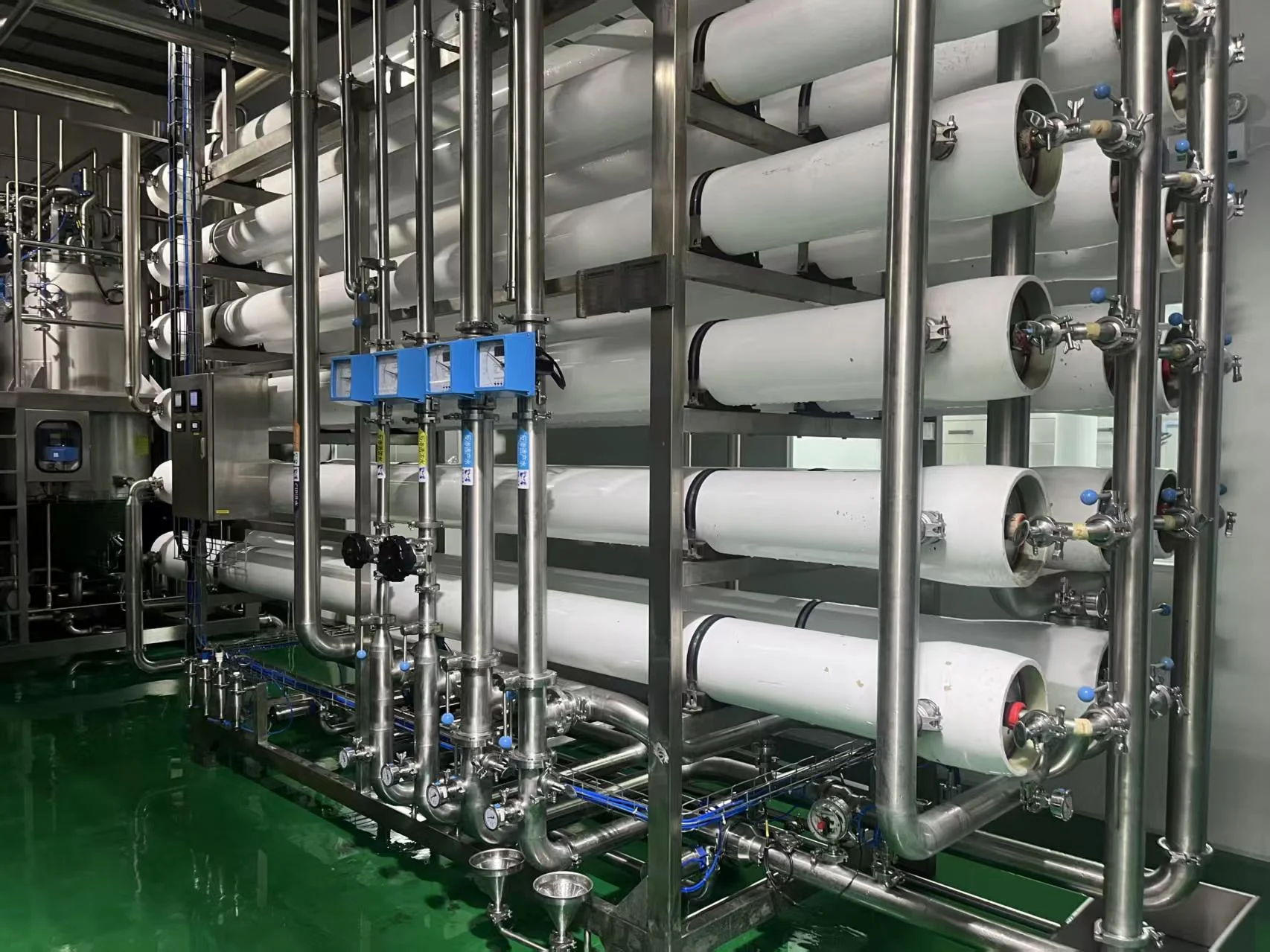
| Reverse osmosis | Dissolved salts, organics, bacteria, viruses | No | Purified bottled water, beverage process water |
| Ultrafiltration | Colloids, proteins, microorganisms, macromolecules (0.002–0.1 μm) | Yes | Natural mineral and spring water |
| Nanofiltration | Multivalent cations, disinfection by-products, organic matter | Partly | Softening surface water and groundwater |
Where source hardness alone is the issue and full desalination is not wanted, an ion exchange system is often specified ahead of the membranes rather than instead of them.
4. Size the capacity above the filler, not equal to it
Treated-water output has to exceed the filler's hourly consumption. This surprises buyers who assume a 12,000 BPH line needs exactly enough water for 12,000 bottles per hour.
Margin is needed for CIP cycles, membrane flushing, product changeover and peak demand. Sizing treatment exactly to filler speed means the line runs dry every time something is cleaned.
In multi-product plants the calculation is larger still, because treated water also feeds sugar dissolving, blending, tea extraction and the CIP circuits — not just the filler. Our 120 T/H system for Anhui Yingjia Mountain Spring was sized around a plant running four product ranges rather than a single bottling line.
5. Pretreatment is what protects the investment
Membranes are the expensive part of the system. Pretreatment exists to keep them alive.
- ·Multi-media filtration intercepts suspended solids and colloids using layered quartz and manganese sand.
- ·Activated carbon filtration adsorbs organics, colour, odour and residual chlorine — chlorine damages RO membranes directly.
- ·Precision cartridge filtration is the final barrier before the membrane stage.
Cutting pretreatment to reduce the quoted price shortens membrane life and raises operating cost for as long as the plant runs. It is the clearest example of a saving that is not a saving.
6. Choosing between UV and ozone
UV disinfection is chemical-free, adds no taste or odour, and leaves no by-products. It works inline, immediately before filling.
Ozone is a stronger oxidant and, unlike UV, provides residual protection inside the storage tank and the sealed bottle. It performs best between pH 5.6 and 9.8 at water temperatures of 0–27°C. The caveat is bromate: where the source contains bromide, ozone dosing has to be managed carefully.
Many plants use both, at different points in the circuit — ozone for residual protection in storage, UV inline before the filler.
Send your laboratory analysis and target output. We will specify the treatment train and return a configuration with a budgetary quotation.
Four mistakes that cost the most
- 1Designing from an assumption. Using a regional water average instead of testing the actual source. Everything downstream inherits the error.
- 2Specifying RO for mineral water. Discovered only when the finished product fails its standard.
- 3Sizing treatment to filler speed exactly. The line stops every cleaning cycle.
- 4Ignoring future expansion. Retrofitting a treatment room after production starts costs far more than oversizing it at the beginning.
For how the treatment section fits into a complete plant, see our bottled water production line guide, or browse the full water treatment equipment range.
Frequently asked questions
Can one system produce both purified and mineral water?
Yes, if designed for it from the start. This normally means parallel treatment trains, or a bypass around the reverse osmosis stage, so both products can be made without rebuilding the water room. Declare both products at the proposal stage.
How much space does a water treatment system need?
It depends on capacity and the number of process stages. Allow clearance around membrane housings for cartridge and membrane replacement, plus separate ventilated storage if cleaning chemicals are used. Workshop dimensions are part of what we need to produce a layout drawing.
Should contact parts be SUS304 or SUS316L?
SUS304 covers most beverage applications. SUS316L is specified where chloride content, hygiene requirements or an export market's process standard calls for it. Confirm before fabrication starts — changing material later is expensive.
How often do RO membranes need replacing?
Membrane life depends on feed-water quality, pretreatment effectiveness, cleaning frequency and operating recovery rate. Adequate pretreatment and a regular CIP schedule are the two factors that extend it most.
Can a new treatment system connect to our existing filling line?
Yes. The system is engineered with treated-water storage, distribution pipework, disinfection and controls for connection to existing equipment, provided capacity and connection points are confirmed first.